
Introduction
This blog briefly explains 5G Resource Allocation: how UE are assigned frequency resource blocks and time slot to transmit and receive data.
First it explains 5G Frame structure that includes spectrum (frequency range) and time slots where physical channel are allocated. Concepts such as Resource Block are explained. However details configuration will be left out, and reference to 3GPP specification and Sharetechnote page will be given
Then it goes on to explain basic configuration for Frequency and Time domain resource allocation to UE.
5G Frame Structure
- Resource grid defines the time domain and frequency spectrum that gNB serves its UEs. The numerology defines the size of the resource grid. (3gpp 38.211 – 4.4.2)
- Resource Element: 1 subcarrier x 1 OFDMA symbol (3gpp 38.211 – 4.4.3)
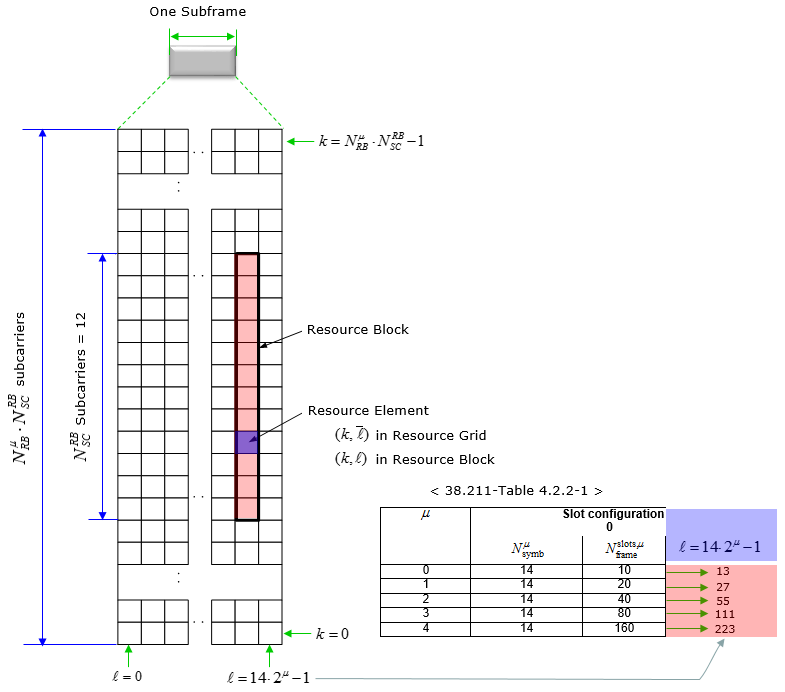
Sample Resource Grid:

Frequency domain:

configuration for one NR channel. Source: Figure 5.3.1-1 38.101
- Subcarrier spacing: 5G defines 15Khz, 30Khz, 60Khz subcarrier spacing.
- The transmission bandwidth of gNB could be 5Mhz, 10Mhz, 15Mhz, 20 Mhz ... 100Mhz (3GPP 38.101). NR bands defines corresponding SCS and total transmission bandwidth.
- Resource block: A resource block is defined as 12 consecutive subcarriers in the frequency domain. Note that RB is a frequency domain concepts and is not related to Resource Element. (3gpp 38.211 – 4.4.4)
- Bandwidth Part: a subset of contiguous common resource blocks (3GPP 38.211 - 4.4.5)
- point A: the center frequency of Common Resource Block 0.
- Resource Element Group (REG) : this concept is only applicable to PDCCH channel. 1 REG = 1 RB (3gpp 38.211 – 7.3.2.2)
- Control Channel Element (CCE) : this concept is only applicable to PDCCH channel 1 CCE = 6 REG (3gpp 38.211 – 7.3.2.2)
Illustrate of Bandwidth Part, Common Resource Block

Time domain:
- Radio Frame lasts 10 ms, and includes 10 subframe, each is 1ms.
- Symbol: 1 OFDM symbol
- Slot: number of symbols per time slots. 1 slot = 14 symbols.
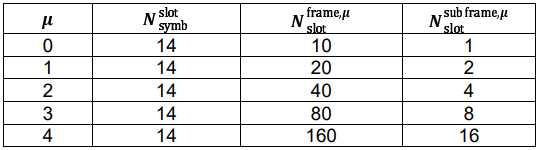
- 1 radio frame can include 10, 20, 40 etc number of slots, depending on the numerology. Thus the number of slot per subframe is also dependent on the numerology. 3GPP 38.211 table 4.3.2-1

Numerology:
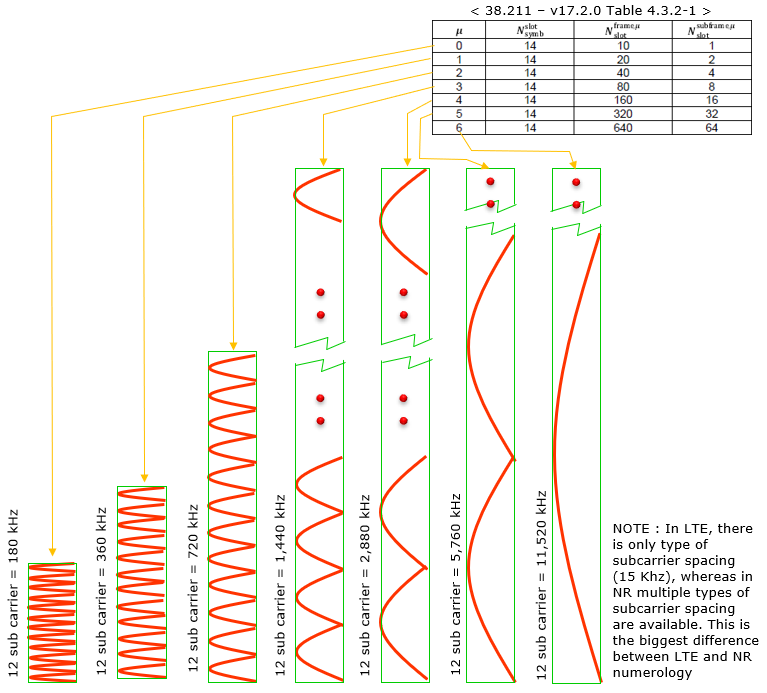
Both time domain and frequency domain configuration is identified by the numerology.
Also, the cyclic prefix type is also defined with numerology.
The following diagram briefly illustrates different Subcarrier spacing (frequency domain), slot per frame or per subframe (time domain) for different numerology.
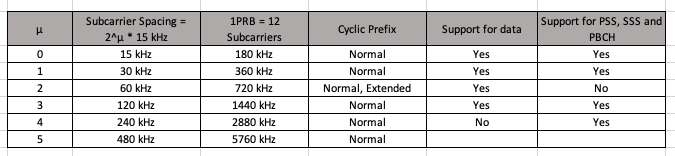
Relation between numerology and Subcarrier Spacing, Cyclic Prefix and PBCH
There is 1-1 relation between Subcarrier spacing (SCS) and numerology.
The applicability Cyclic Prefix length is also dependent on SCS.
Relation between numerology and slots
The number of slots per subframe and per frame changes according to numerology.
Frequency Domain Resource Allocation
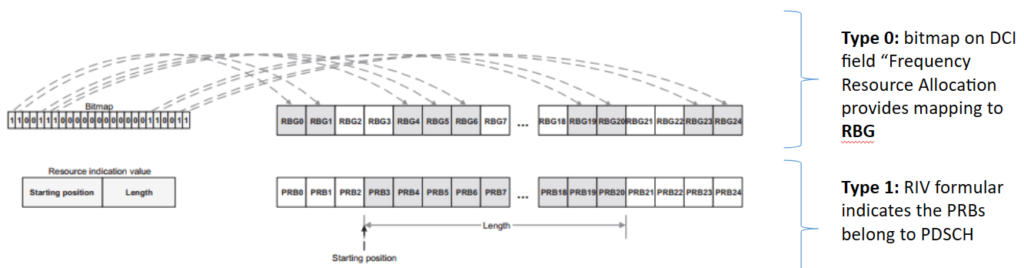
- Resource allocation type 1 allocation is based on indicating the starting position, length of PDSCH in term of PRBs.
- Resource allocation type 0 allocation used bit maps which are provided by DCI. The bitmap maps the bits to the Resource Block Group used by PDSCH => gives flexibility and possibly non-contiguous allocation.
Time Domain Resource Allocation
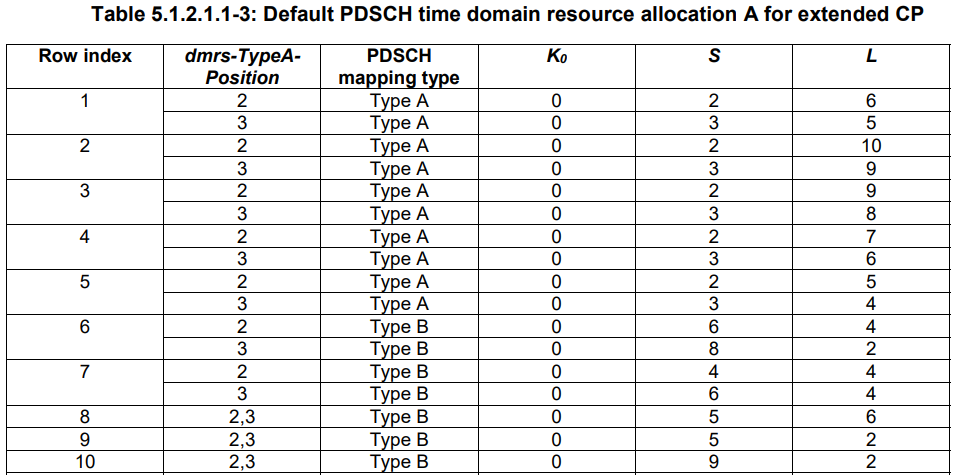
DCI provides Time domain resource assignment field value which is the index of allocation table 5.1.2.1.1-3. From that value, S (starting symbol) and L( number of continuous symbols from starting symbol) is indicated
Type A or Type B allocation is also dependent on the associated dmrs, cyclic refix.

Allocation table for PDSCH:
Conclusion
I hope the blog gives a refresh review of 5G radio frame and a general idea of how physical channels and UE are offer resources to transmit data.
The actual configuration is a lot more complex that those given here. I would suggest viewer to look over 38.101, 38.212, and 38.214 for more details and accurate information.